When buying his first laser device, a novice master of laser tattoo removal carefully reads the descriptions of lasers: characteristics, energy parameters, and what functions the laser will perform. And here comes the problem: how to choose the right one from all the variety of devices? After all, every seller praises his product!
But to choose the most tricked-out laser according to the description does not mean to choose a really good device.
Vendors very often write outright nonsense in compact laser device descriptions on websites and in posts on social networks!
I have 2 theories about this:
They themselves believe the nonsense they write.
They deliberately mislead their potential buyers, roughly speaking – they want to deceive.
Both versions speak from the bad faith and incompetence of sellers/manufacturers/suppliers/resellers of compact PMU and tattoo removal lasers. They do not want to sell you a really quality machine, but simply “make a profit” on you.
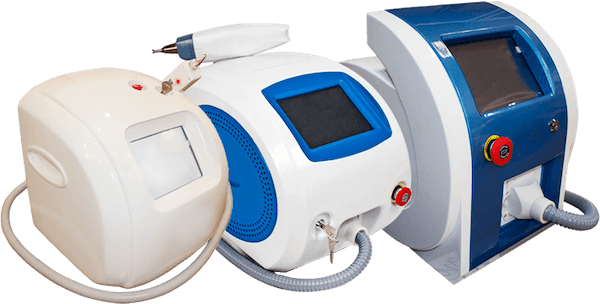
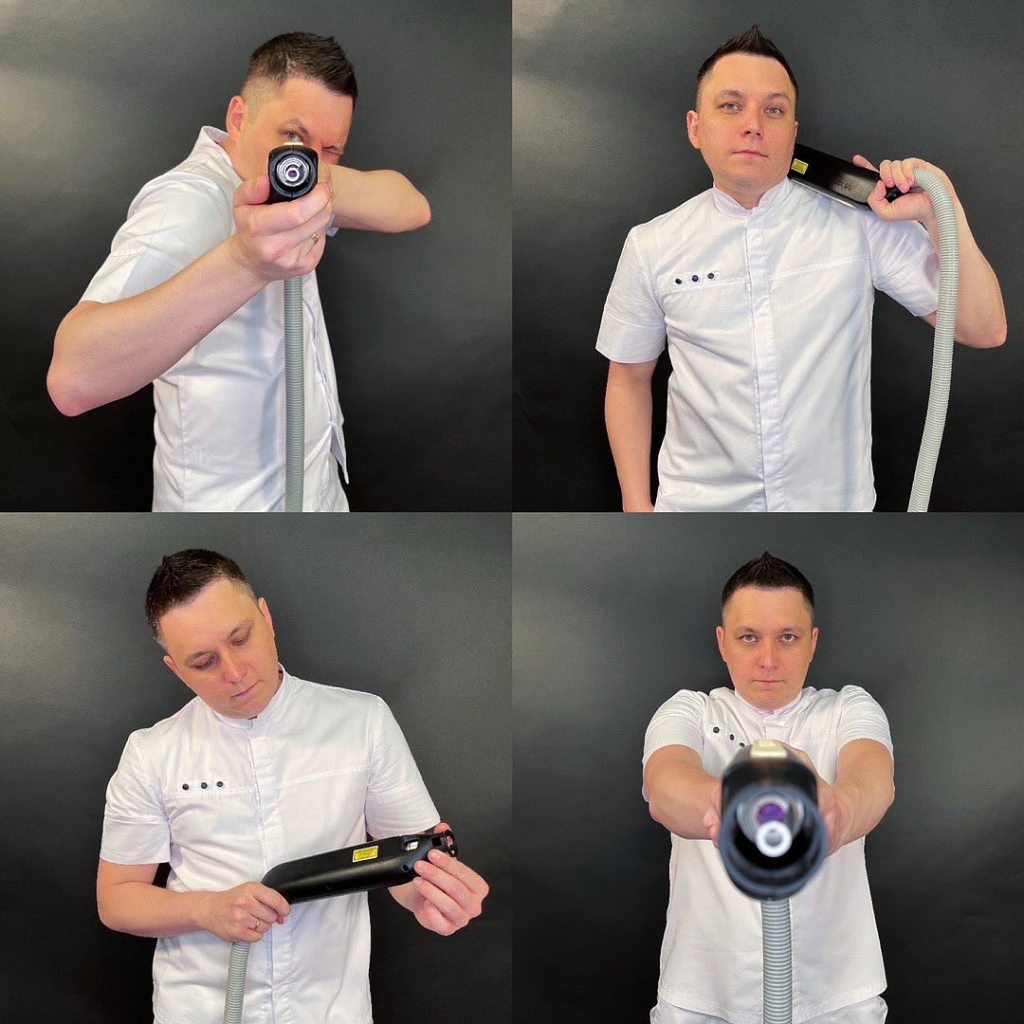
First, let me show you what compact lasers look like:
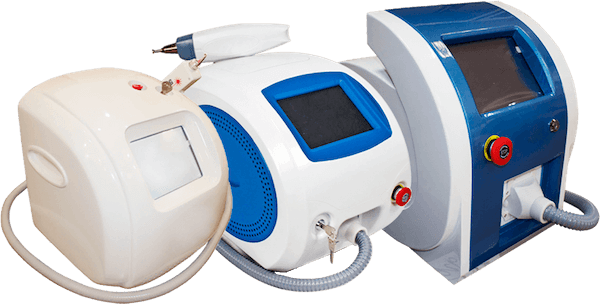
It’s a small box and a handpiece-gun on a hose.
Let’s move on to the myths. I specifically looked at the websites and social media sites of the suppliers of compact units – I ended up collecting 20 of the most popular (delusional) phrases from their descriptions and features.
MYTH #1. The main myth I observe in the market of compact neodymium lasers for PMU and tattoo removal is their energy (mJ). Sellers of devices on every corner shout about the power of their lasers: 1000 mJ, 1600 mJ, 2000 mJ, etc.
Sounds promising, because you think the more millijoules written in the description of the laser, the better. So it will remove tattooing faster and better!
This is a big misconception! The compact laser can produce energy of 2000 mJ, but its efficiency is almost independent of this indicator.
Chinese manufacturers can write on the device as many millijoules as they want, but you do not need them!
Why? A compact laser is not able to give out all its energy in one pulse, so it divides it into several small portions of energy. Only the first portion of energy in this pulse-train will be effective for tattoo removal! And it doesn’t matter what energy is written in the laser description. This is due to the engineering design of compact lasers and the passive optical gates used in them (we will talk about this in other posts).
MYTH #2 Laser power. The phrase “Our laser is the most powerful. The power of 1600 watts will provide up to 8 hours of continuous laser work!”
And now the truth. Laser power (watts) indicates how much power the laser consumes and it has nothing to do with the hours of continuous laser operation.
You should not be concerned about the amount of power consumed! It has nothing to do with the quality of the machine and the effectiveness of the results of PMU and tattoo removal.
Plus, you wouldn’t be able to run the laser continuously for hours because there are nuances with crystal overheating that you shouldn’t allow.
MYTH #3 “Starts at 1mJ and is infinitely adjustable in 10mJ increments.”
This does not work on compact neodymium lasers! There may be a “smooth adjustment” on the screen, but the unit actually only pulses at about 200 mJ +/- 20% increments
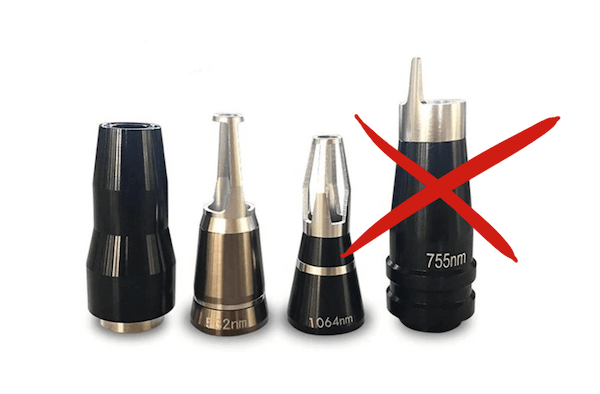
MYTH #4 “The 755 nm nozzle in a compact laser.”
Indecently I often see this nozzle in the descriptions of devices. It supposedly removes all colors of pigments – even yellow, green, and blue. Masters are bribed by such a marketing move about “super nozzle”.
Attention! Nozzle 755 nm does not exist for compact neodymium lasers. You are available only two waves: 1064 nm and 532 nm.
MYTH #5 “Three wavelengths: 1054/535/1320 nm.”
A harmless myth that says that the carbon peel nozzle on a neodymium compact laser makes a 1320 nm wavelength. You can disregard this.
The carbon nozzle does not change the wavelength, it remains 1064 nm as it is.

MYTH #6 “Special unique ruby or sapphire crystal.”
A marketing ploy by laser vendors that is used as an advantage for buyers.
Truth: A compact laser only has an Nd:Yag crystal, i.e. neodymium! Sometimes there are lasers with Nd:Ce:Yag (with additional cerium).
That’s it! No ruby, sapphire, etc.!
MYTH #7 “3rd generation crystal with amplified harmonics.”
A phrase from the website of one compact laser that carries no information.
First, there are no generational crystals.
Second, what have they amplified? How? Why? It is not clear.
MYTH #8 “British/American lamp with a 10 million flash life.”
Such lamps do exist, but they have nothing to do with compact lasers!
The average life of neodymium compact lasers is 1 million flashes.
The maximum life of a compact laser lamp that I have seen is 2-2.5 million flashes, and that is with very careful use on low energy levels.
MYTH #9 “This laser doesn’t make wounds or burns!” – is a favorite phrase of laser salesmen.
But any, even the most expensive neodymium laser is dangerous, because it belongs to the 4th class of danger. If used incorrectly, the laser can cause serious injuries: wounds, scars, and blisters.
At the same time, the laser is not dangerous in itself. It is dangerous in the hands of an unqualified specialist who operates it!
MYTH #10 “The menu has preset programs with all the necessary settings”.
It turns out that the buyer does not need to think at all, just turn on the laser. And the rest of the settings have been carefully provided by the manufacturer.
Nonsense. Behind the buttons in the compact laser menu “Remove tattoo”, “Remove PMU” “Remove red tattoo”, etc. is nothing! The laser will not do all the work for you, you have to think for yourself.
Read more about the remaining 10 myths about compact tattoo removal lasers here: “20 myths about compact lasers for tattoo and PMU removal (PART 2)”


 Laser Blog
One response to “20 myths about compact lasers for tattoo and PMU removal (PART 1)”
[…] Part 1, we discussed the 10 most popular myths about compact lasers that are written by salespeople and […]
LikeLike