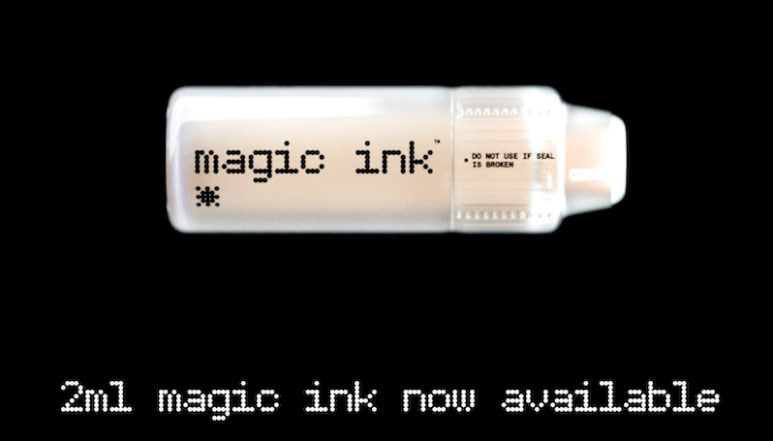
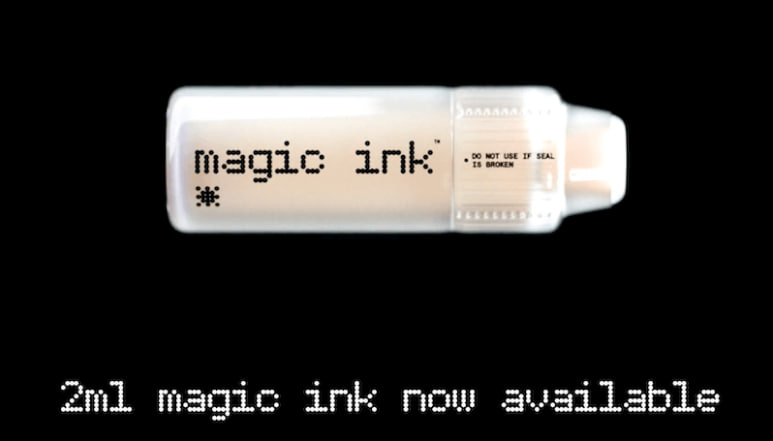
In mid-January, there was a high-profile release of a new product in the tattoo industry – photo-activated tattoo ink “Magic ink”. Here is one of the most complete interviews with the creators of this ink:
An innovation in PMU from famous artist Keith “Bang Bang” McCurdy

This innovation in tattoo from famous artist Keith “Bang Bang” McCurdy allows you to activate and deactivate tattoo ink with a flick of a light. Quite simply, with these new “Magic Inc”, you can simply “deactivate” your tattoo whenever you want.
Keith “Bang Bang” McCurdy has tattooed Rihanna, Justin Bieber, Cara Delevingne, and many more stars, but his passion for creating goes beyond that. “I’ve always said that my inspiration fuels my motivation,” Bang says in an interview.
The inspiration and creation of Magic Ink
Innovating in the body art space is a driving force for Bang, and “tattoo inks have always been one of those things on my board,” he says. However, developing ordinary, run-of-the-mill inks felt too easy – he wanted to dream bigger. “There are lots of companies that make tattoo products, not many of them are owned or operated by tattoo artists,” he says. “It’s near and dear to my heart to create products and help lead those projects as a tattoo artist and involve tattoo artists early, instead of late, as endorsers.” After dreaming up the idea for Magic Ink, he got to work.
In his research, Bang discovered Carson Bruns, PhD, an assistant professor at the University of Colorado Boulder who made a tattoo on himself that he called the “solar freckle” with the purpose of detecting ultraviolet light to prevent skin cancer. Fascinated by the idea, Bang traveled to Colorado to see for himself the light-activated tattoo on Dr. Bruns’ skin. This got him thinking about how the technology could be adapted for consumer use, and he began working on the project with the help of a scientist. The original technology behind the ink has been in development by Dr. Bruns for about six years, but Bang partnered with him about two years ago to create HyprSkn, the parent company for this new endeavor, about two years ago.
“Although Dr. Carson’s early idea was honorable, [Magic Ink] has been engineered differently than to activate and deactivate by UV light just at will,” Bang says. “It’s much more controlled, and the formula is much more precise now.”
What is magic ink made of?
Magic Ink is made from a noncytotoxic dopant, which is the photochromic “magic” ingredient in the formula, and polymethyl methylate, which is what dermal filler is made from. Unlike tattoo pigments, which are made with milling agents, HYPRSKN implants are PMMA nanospheres created without milling and reinforced with dopants as active ingredients.
Main ingredient: biomedical grade PMMA
PMMA, or polymethyl methacrylate, is a clear polymer glass that has been safely used in medicine for more than 70 years in dermal fillers, hip replacements, bone cement, and more. In HYPRSKN implants, a biocompatible PMMA shell encapsulates the pigment, limiting direct interaction between the pigment and body cells.

Advantages of PMMA include:
- Excellent biostability. PMMA polymer chains are flexible, yet very stable and biocompatible, making them ideal for biomedical implants. The body does not break down or react negatively to PMMA, which is why PMMA is widely used in biomedical implants, dentistry, and prosthetics.
- Exceptional transparency. Because of its high transparency, PMMA is often used as an alternative to traditional glass and is suitable for everything from impact-resistant windows to optical fibers.
- High purity. “PMMA is widely available in medical grade purity, which we always use in our products to ensure safety and biocompatibility”.
Dopants are low-concentration additives that are introduced into a bulk material to modify its properties. HYPRSKN dopants change the optical properties of PMMA nanospheres, allowing them to change color (as in Magic Ink) or scatter UV light while remaining invisible (as in Invelanin).
HYPRSKN dopants are custom-made to unprecedented standards of purity and quality, unlocking revolutionary features for intradermal implants.
“Magic Ink is optimally sized so your immune system can’t take it away.” The ingredients in the ink are also biocompatible and meet medical standards.
How does Magic Ink work?
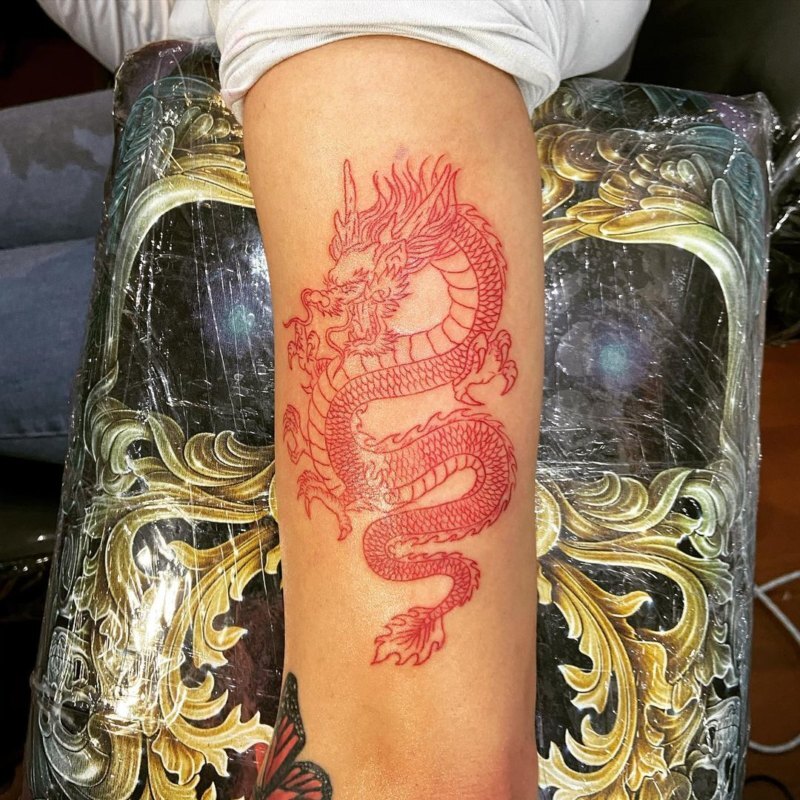
The process of getting a Magic Ink design is exactly the same as getting a traditional tattoo. “For us as artists, that’s important because we have visual and several other variables that tell us we’ve put ink in the skin correctly,” Bang says. At the moment, Magic Ink is only available in red ink, but they plan on rolling out more colors in the future.
During that initial healing phase, it’s not recommended that you activate and deactivate your tattoo, but a few weeks later, when your ink is fully healed, you get to enjoy the full effects of your magical piece of artwork.
The ink is turned on and off by specific wavelengths of light. “One wavelength of light will activate your tattoo, and that’s activated by actually changing the structure of the particle,” Bang explains. This is what shows the color. “Then, if you give it a different wavelength of light or visible field of light, that structure will change again, and it won’t show color.” Though it’s a little different, Bang says, “[it’s] kind of the same idea as a coffee mug that shows a picture when it’s hot.” (Though that’s thermochromic, whereas Magic Ink is photochromic.)

Any form of visible light can activate the tattoo, including the flashlight on your phone, and to reverse the reaction, you use a UV flashlight. These two forms of light can display and hide the ink within seconds. To change the design within your skin, which was another dream of Bang’s, the idea is to tattoo a solid area of Magic Ink and use light to activate specific particles.
“We made this thing called the Magic Pen, which is more like a stylus for your skin,” Bang says. “It’s a very narrow beam of light that you can draw on your skin, and it will only activate wherever particles it exposes to light.” With the Sharpie-like light pen, you can create whatever design you want in the patch of Magic Ink. “You can also use stencils and you can stick it right on your skin and put a light across it,” Bang says. This means you can change your tattoo as many times as you want.
Is Magic Ink safe?
Your emotions are probably wavering between amazement and skepticism, which is fair enough; Bang admits how incredible the whole concept seems. “My first thought was, ‘This is too good to be true. Is this OK? Is this safe?’”. And he assures us that it is. The ink was developed by a team of scientists with doctorates in their fields and a medical advisory board. Additionally, New York City dermatologist and dermatopathologist Adarsh Vijay Mudgil, MD, has reviewed the Magic Ink tattoos that have been done over the last two years. According to Bang, “We’ve done studies where we compare the safety and healing process of Magic to conventional inks, and it performed as well or better than standard tattoo inks.”
With all that said, we don’t know exactly how Magic Ink will age, as the product is still fairly new. But the team isn’t losing optimism. “It will be 20 years before we know how it will break down, but any pigment breaks down,” says Bang.
The Future of Tattoo With Magic Ink
Magic Ink rolls out to the world on Jan. 17, starting at Bang’s studio in New York City, where it will be used exclusively for a few months. “Then we will share it with our legacy artist team — some of the most prestigious, most followed, most famous tattoo artists in the country and all over the globe,” he says.
Bang is excited to see how Magic Ink is adopted into the world of tattooing but doesn’t see it replacing traditional designs. As he puts it, “I really wanted to marry the two. I’m a tattooist; I love tattoos.”
From myself I will add that the idea is undoubtedly very interesting!
This is not the first attempt to realize the dream of millions of people and make “disappearing” tattoos, but so far one of the most successful both in terms of marketing and in terms of bringing from the idea to a commercial product!
If in time there will be a whole palette of such inks (and not just one red, as at the moment), it will open up the imagination of tattoo artists in the artistic realization of multi-dimensional tattoos with variable designs!
In any case, this is a great and promising breakthrough in the creation of bioinert-coated tattoo inks, which has every chance to develop into a new round of evolution of PMU and tattoo inks.
So far, there are no reliable published scientific studies on the behavior of these inks in the human body, as well as on their interaction with tattoo removal lasers. But I think they will appear in the future – let’s follow the development of this StartUp together!
Share with your colleagues and follow the news on my blog!
Source: Read More
Magic Ink’s official website: Visit Here
Bang Bang NYC Official Website: Explore

 Laser Blog
Leave a comment