Introduction: Approach to Complex Cases
I was sent this case the other day by one of my followers, and she sent me a whole series of photos from the initial stage, when the tattoo was not yet lasered, to the current situation, how she got a complication from laser tattoo removal. Why is this a typical situation, and why are mistakes also quite typical?
Major Risk Factors

Initially, if you look at the photo, you will see that the tattoo is black and quite saturated, and if you look closely, you can see that it is already covered up. After correspondence with this follower, I found out that there were three tattoos, one on top of the other, from different tattoo artists. So, they are all done in black, and the amount of pigments in the skin is relatively high. This is the first risk factor because covering up is always much more dangerous in terms of complications with laser removal. Next, the tattoo is located on the inner side of the forearm, and the patient is a woman, so the skin is relatively thin, especially on the inner surface of the forearm. This is the second and also significant critical risk factor. If we summarize the two risk factors, the overall risk can be immediately assessed as ultra-high for tattoo removal. Therefore, you had to be very careful here.
Laser Tattoo Removal Procedure Mistakes

The following photo shows the condition of the skin immediately after treatment. Notice that the diameter of the treatment spot is tiny. I know that it was treated with a compact laser. Unfortunately, I don’t know what energy the technician who did the procedure was using. However, the energy may have been high as well. Why? Because there is a misconception in the minds of inexperienced specialists who are not deeply immersed in the topic of laser removal that if there is a lot of pigment and the tattoo is saturated, then you need to increase the energy to get sound effects and remove the pigment faster. This is an extremely dangerous misconception because, in such a situation, compact lasers work in the mode of pulse packets. That is, they produce many small portions of energy in each pulse while increasing the energy on the screen. And this is also a very high-risk factor for getting complications. Plus, it’s a small spot. A small spot indicates that the energy density was very high, and therefore, the impact on the tattoo was super intense. When combining the factors of a large number of skin pigments and thin skin, this is, well, the cherry on top and provokes further complications.
Developing Complications After Laser Tattoo Removal

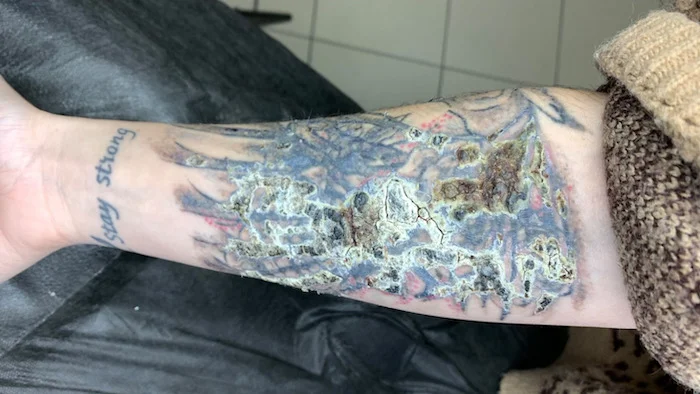
What happened next? Classic development of events. Not only that, immediately after the tattoo is visible, there is extreme redness and intense trauma to the skin due to the work of a small spot; a few hours later, blisters on the skin begin to appear and burst. The swelling increased very much, and the blisters started to appear.
This is the standard development of the situation in such a case, with such a combination of factors. In this case, the specialist who performed the procedure needed to make the correct recommendations. There was no recommendation to control the inflammation with cooling, but rather a recommendation to wear Bepanthen cream and cover it with a film. Overall, it also made the prognosis worse because the film interferes with heat exchange, any reduction in temperature in the tissues, and an overall decrease in inflammation. All of this together produced some very unpleasant consequences. Most of the tattoo is covered with blisters of varying degrees of severity, from large to small.
A Critical Sight At The Laser Tattoo Removal Process

After a few days, all these blisters burst, and the entire tattoo is covered with severe crusting. This is very unfortunate because eventually, such a severe trauma with such thin skin has a 95-99% chance of ending up with rough scar formation. Unfortunately, there are no photos of how this tattoo has healed, but the follower promised to send it when the regeneration is complete.

In general, this is a standard typical set of mistakes that are made by a vast number of incompetent specialists who take lasers into their own hands and do not understand what they do. All possible critical mistakes that should not have been made were made here. The result is logical. The person, the client, will remain scarred enough for the rest of his life, while the tattoo will not be removed. Further removal of such a tattoo will be challenging, so I urge everyone who decided to start removing with a laser specialist to immerse themselves in the topic of laser removal and not make such silly mistakes. Mistakes will still be made, but in general, they are not so gross and not so typical. Therefore, all this could be avoided and done without the formation of scars.
Conclusion And Cautionary Note
This case study serves as a reminder to all laser tattoo removal specialists of the importance of competence and care in their work. Mistakes are inevitable, but a thorough understanding of the method and caution can minimize their effects and ensure the safety and effectiveness of the procedure.