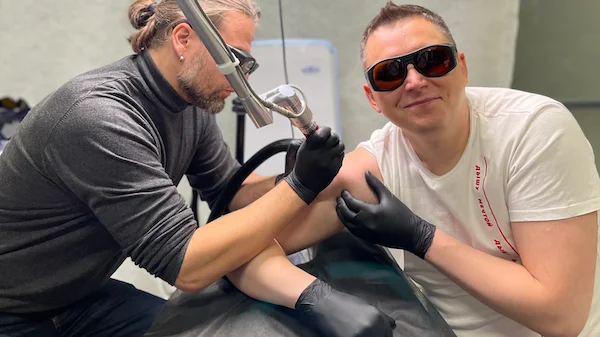
Back in 2017, I had the idea to clearly show everyone that tattoos can be removed by laser safely and without any consequences for the skin. But there was some problem. I didn’t have any tattoos. What was the solution from here? Very simple. I had to get tattoos. So I took that step. I invited a local good tattoo artist to my clinic and asked him to give me two tattoos. Why two? Because I’m a scientist, I was interested in doing a split test. I asked the tattoo artist to make my tattoos as similar as possible in size and saturation, with the same ink, with the same needles and machine on two parts of my body. I got tattoos on the deltoids of my upper arm.

The tattoos had no aesthetic value whatsoever. I did not do them for beauty, so they were just squares, something resembling the Windows logo. The square consisted of four parts with different degrees of saturation, from the palest, with the smallest amount of pigment, to the most saturated. I shot it live, and somewhere, I even have a video of me getting tattooed. So that there was proof that the tattoos were real. Next, I waited about nine months or so before getting them removed.

First Tattoo Removal Session
At the first tattoo removal session, my goal was to simulate a complication. I took this step deliberately and asked my doctor at my clinic to perform the procedure as aggressively as possible in separate bursts to provoke a complication and see how it would play out. So, we raised the energy density of the laser very high and did separate flashes on different squares. But, most interestingly, we haven’t got a complication.

But we did get a fascinating and paradoxical artifact. Literally, after a few hours, I saw that in the places of separate flashes pigment, it was carbon black, ordinary black tattoo pigment, just disappeared. That is, I saw clear skin with no trace of pigment at the individual flash sites. This was shocking to me because I couldn’t explain it. Before that, there was a description everywhere, in articles and scientific publications, that pigment is eliminated long after laser treatment with the help of immune system cells. This process is long and takes a very long time. And here we saw something incredible: the pigment had JUST disappeared. This kept me awake for days, and we decided to try to repeat the experiment. And yes, we were able to repeat the same effect on other tattoos. The primary condition was that the tattoos had to be quite old and not super saturated with pigment. We saw this repeatedly, and it was astonishing.

Paradoxical Discovery And Patent
I couldn’t find an explanation for this fact, where the pigment went. However, after searching and digging in the literature, scientific articles, and studies, I found an explanation for this phenomenon. It explained exactly the behavior of carbon-black pigment and did not work with other pigments, but with carbon-black, it worked. It’s called the vapor-carbon reaction. It was described about 15 years ago in experiments, but here we observed it with our own eyes, and it was very surprising.
Therefore, based on the results of this initial experiment, my doctor and I took out a patent, where we described the methodology of how to remove pigment in one session. The patent can be found at this link.
However, the further removal was less rosy than the first one. The pigment particles that surrounded the areas that were cleaned changed their structure, and it was more challenging to remove them further. We could not get the same effect on the areas next to us that were not treated in the first session. We were disappointed, but the fact and the phenomenon that it is possible to achieve complete skin cleansing with individual flashes is very inspiring.

Conclusion And Insights From The Experiment
Moreover, another interesting fact came to light. This treatment partially, when we treat 50% or 30% of the tattoo in one treatment, and not the whole area at once, is an increase in safety. That is, with this mode of operation, it can be processed at much higher energy densities, achieve almost clean skin in the treatment areas, and at the same time very much reduce the risk of complications because foci of inflammation in the skin will be separated from each other areas of skin without inflammation. And the total area of the tattoo will withstand a more significant load of laser energy. At the same time, the probability of getting a complication will be much lower. That is why we have fixed these two facts, these two phenomena, in the form of a formalized patent for the method of tattoo removal.
It is a pity that it was not possible to remove the entire tattoo with this method completely, but wow-effect for clients can be achieved when you show a test flash and the person in this place literally the next day, for example, he sees a clean skin. It is essential, to tell the truth that with the whole tattoo, such a trick will not work, but it is also a tool to work with saturated tattoos, with large areas of tattoos, when the treatment of the entire area of the tattoo is hazardous in terms of complications. And you can divide the treatment into 2 or 3 stages to reduce the risk of complications. It really is much safer.
P.S.

By the way, I did have my tattoos removed. Of course, I am not a very obligatory client for laser removal, and I removed and treated them with laser, and different lasers and nanosecond picosecond, just in case I did not observe the terms, but nevertheless, in 3-4 years, I have no tattoos left on my shoulders, and I even forgot where they were. So, the experiment from this point of view was also successful.