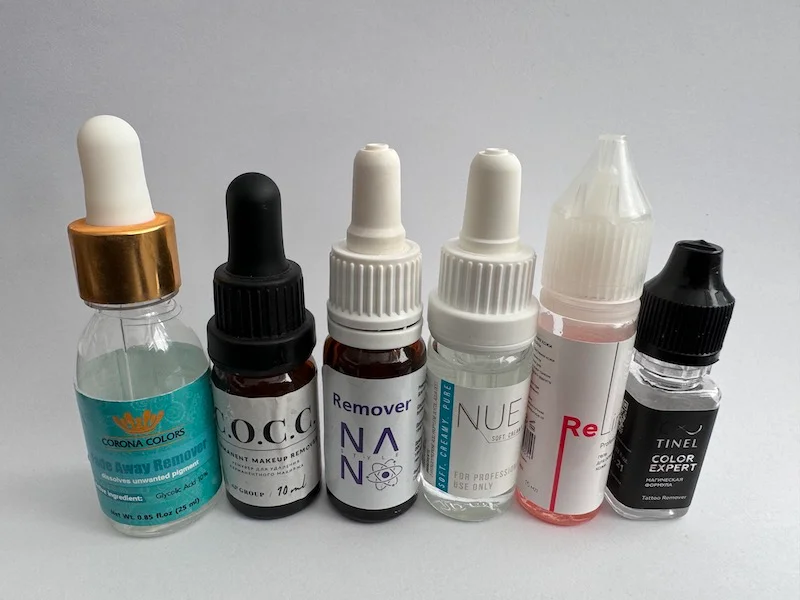
Acid chemical removers are unique compositions with which permanent makeup artists remove pigment from the skin. These specialized products are used to correct or remove failed work, as well as to cleanse the skin from artificial pigment.

Features of The Composition of Acid Chemical Removers
This is a very heterogeneous group of compositions that may contain fruit acids such as lactic, glycolic, malic, phytic, and other acids in their composition. Usually, these are relatively weak acids that have long been used in cosmetology for superficial chemical peels. Still, in this case, they are introduced into the skin, not on the surface of the skin.
The Importance of Information About The Composition of Acid Chemical Removers
At the same time, this group is very heterogeneous, and the pH level can be completely different, from pH, for example, 4.5-5 to pH 1.2. This dramatically changes the properties of these compositions.
It is extraordinary, but for some reason, producers often do not indicate on the labels of their chemical removers what concentrations of acid they use, as well as what pH level. This is very strange to me because it is critical to assess the aggressiveness of these chemical removers because a chemical remover with an acidity pH of 4.5 and a chemical remover with an acidity pH of 1.5 will differ in its aggressiveness to tissues and ability to cause inflammation and destruction in tissues more than 2-3 times. Therefore, I’d like to ask permanent makeup artists who use chemical removers always to find out the pH level of acidic chemical removers because it is critical for the safety of the procedure.
If the producer, for some reason, did not specify or hide this information, justifying it by the fact that it is a trade secret, I highly recommend specialists to use special test strips in order to determine the pH level of acid chemical remover.

Application And Safety of Acid Chemical Removers
Acid chemical removers are characterized by the fact that they cause relatively controlled damage in the tissues. This is known as coagulation necrosis. When acid is exposed to the skin, it interacts with the proteins of the skin, with collagen, causing it to coagulate.

Thus, when the acid interacts with the collagen of the skin, it neutralizes itself, and, in effect, self-limiting damage occurs. But you don’t have to relax and think that it’s safe. The acid will neutralize itself, and all is well there. No, in fact, acid chemical removers can damage the skin very severely and intensely, to the point of completely breaking down and causing scar formation. It is perfect when producers supply their acid chemical remover neutralizers so that it is possible to stop the effect of acid on the tissues. In cosmetology, chemical peels based on fruit acids are almost always supplied with neutralizers.
Neutralizing And Controlling The Effects of Acid Chemical Removers
In this case, I highly recommend you keep a balance between mechanical trauma and chemical trauma to the skin. The principle here is as follows. The more aggressive the chemical remover is, i.e., the lower its pH and the higher the concentration of acids, especially glycolic acid, the less mechanical trauma should be inflicted and, if possible, neutralized, not leaving the acid in contact with the tissue for a long time. Literally, it should be a very short-term exposure and neutralization.
Advice For Beginners On Working With Acid Chemical Removers
The general advice when working with removers is moderation and extreme caution. Because an attempt to remove pigment at once, an attempt to influence more strongly, to remove more strongly, often turns out to be huge problems. Destruction of the skin, prolonged inflammation, the formation of rough crusts on the skin, and, as a consequence, the formation of scars. Therefore, if you have no experience with acid chemical removers, I would recommend starting with the weakest ones, with those whose pH will be around 4.5-5, and working very carefully with them. Yes, their effectiveness will be lower, but the risks of permanent damage and skin breakdown will also be lower.
Conclusion
Please do not rush into the maelstrom with your head, do not grab the first available chemical remover, but do it consciously, choose a less aggressive one, gain experience, gain visibility of how the skin behaves, how it regenerates, how it tolerates trauma and only then gradually increase the intensity of exposure. Still, please do it very, very carefully.