Permanent makeup artists often don’t think about why they schedule a touch-up after 30 days for almost all their clients. This is usually because they were taught to do so during their basic permanent makeup training. However, there are specific reasons why this isn’t always the best approach.
The Physiology of Epidermal Renewal
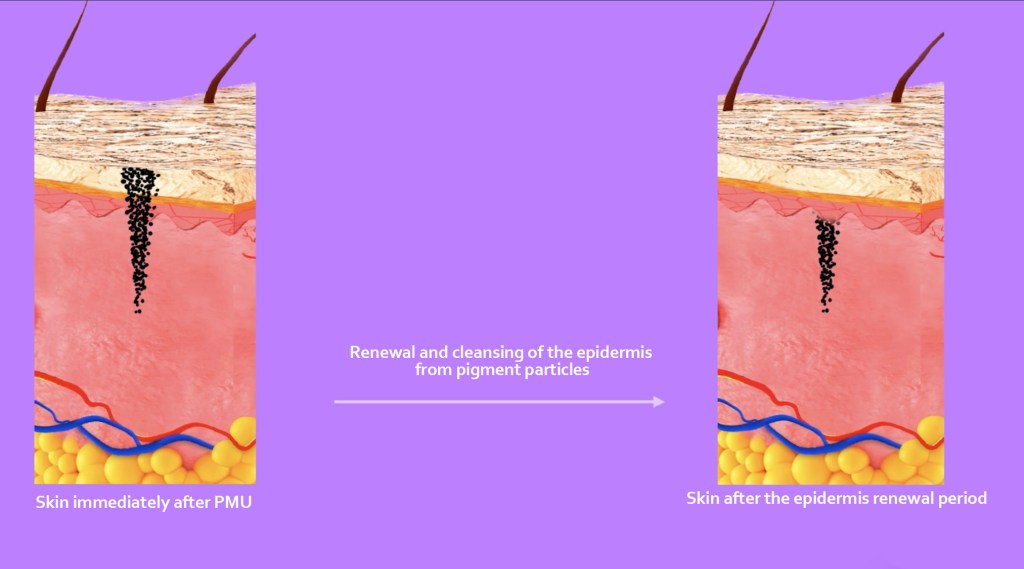
To understand why different clients may need a touch-up at varying intervals, we need to examine the physiology of epidermal renewal. During the initial procedure, the artist injures the epidermis and dermis while depositing pigment. We’ve discussed the mechanism of pigment implantation in another article—check it out here. The pigment colors not only the dermis but also the upper layers of the epidermis.
Immediately after the procedure, permanent makeup often appears quite vibrant, which can alarm clients. However, experienced artists know that this brightness will fade. Over time, the pigment becomes 40–50% lighter compared to how it looks right after the procedure. This initial brightness is due to pigment particles in the epidermis, which intensify the color.
As the epidermis renews itself, old cells are replaced by new ones. Pigment particles located in the epidermis are shed along with dead skin cells, leaving only the pigment in the dermis. This gradual process of epidermal renewal is key to determining the timing for a touch-up.
Timing Touch-Ups and Age-Related Factors
The timing of a touch-up is directly linked to the epidermal renewal cycle. For young individuals around 20 years old, the epidermis on the face typically renews itself in 28–30 days. However, as people age, these processes slow down. In people aged 30–40, renewal takes longer, and by the time they reach 50–60 years old, it slows even further.
To avoid mistakes in timing a touch-up, it’s essential to wait for the epidermis to fully cleanse itself. This ensures that the artist can accurately assess how much pigment remains in the dermis and what corrections are needed.
A Simple Formula for Determining Touch-Up Timing
How can you determine the appropriate timing? Use this simple formula: the client’s age in years + 10. This gives an approximate touch-up interval in days, which corresponds to the epidermal renewal cycle.
For example:
- If you are 40 years old, your touch-up should be scheduled after 40 + 10 = 50 days.
- Scheduling a touch-up after only 28–30 days would not allow enough time for the epidermis to fully renew, leading to less precise corrections.
Improving the Quality of Permanent Makeup
By applying this formula and scheduling touch-ups later for older clients, you will enhance the quality of your work. You’ll be able to see the actual pigment remaining in the dermis, rather than relying on the temporary pigment in the epidermis. This results in more precise corrections and higher-quality final outcomes.
Permanent makeup artists who adopt this approach have significantly improved the accuracy of their touch-ups and the overall quality of their work. Feel free to use this method—it will help you achieve better results and more satisfied clients.

 Laser Blog