
Why Do Blisters Occur After Laser Tattoo Removal?
This is a very interesting question because blisters themselves are a tricky complication of laser tattoo and permanent makeup removal. They rarely appear during the procedure itself and often develop 4, 6, or even 8 hours after the client has left. So, what are they?

Debunking the Myth of Thermal Burns
Many believe that blisters are thermal burns caused by laser exposure. However, this is not the case. If they were thermal burns, they would appear much sooner. Moreover, nanosecond and picosecond lasers hardly produce thermal effects. While compact lasers may have some predisposition toward this, it’s a topic for another discussion.
Nanosecond and picosecond lasers have such short pulse durations that they don’t have time to generate significant thermal effects. Pigment particles heat up so rapidly that they cannot transfer heat to surrounding tissues—they simply explode. This can be likened to a tiny micro-explosion, as though a small grenade detonates in the skin under the laser’s influence. The resulting microscopic fragments damage surrounding skin tissues as they scatter. The more intense the laser’s impact, the higher the pigment concentration, and the thinner the skin (less dermal tissue), the greater the likelihood of blisters.
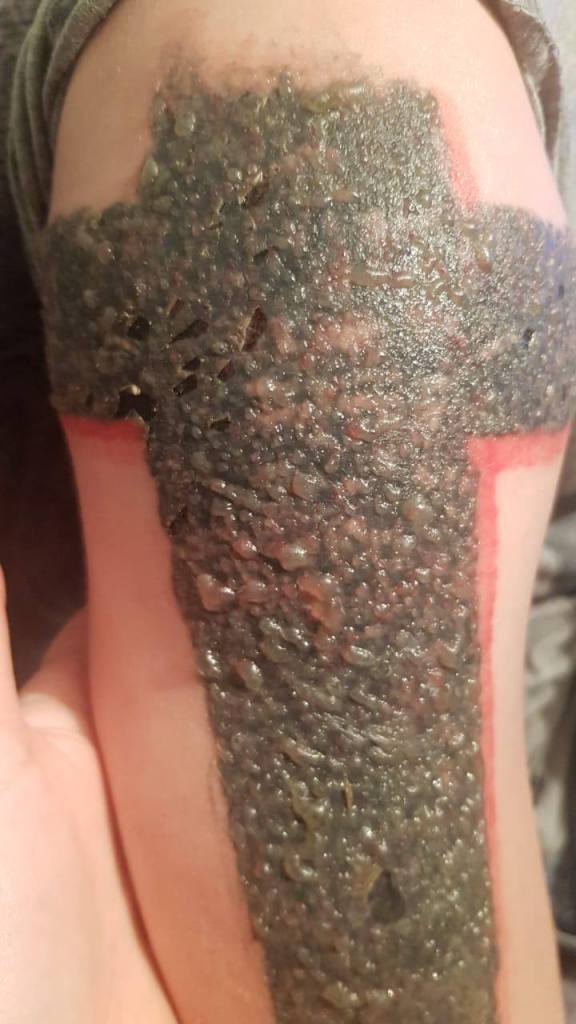
Causes of Blisters After Laser Tattoo Removal and Potential Consequences
Blisters result from excessive inflammation spiraling out of control. Increased vascular permeability and swelling lead to complications like epidermal detachment and the seepage of tissue fluid, forming liquid-filled blisters.
This is not the worst complication that can occur, as there’s a 50% chance the issue will resolve, heal fully, and leave no scars. However, if the inflammation is severe and no measures are taken to control or reduce it, the epidermis may detach at deeper levels, potentially at the basal layer. Sometimes, the blister’s contents are not clear but blood-tinged, indicating severe trauma to the skin. In such cases, the likelihood of scarring increases significantly. Thus, blisters are simply a manifestation of inflammation.
Picosecond Lasers and the Risk of Blisters
Picosecond lasers are particularly noteworthy in this context because their technology emphasizes reducing photothermal effects while enhancing photoacoustic effects, which break down pigment particles. While thermal effects are less pronounced, the likelihood of liquid-filled blisters is slightly higher with picosecond lasers compared to nanosecond lasers. This is because picosecond lasers have higher peak intensity, and the acoustic wave further damages surrounding tissues alongside breaking down pigment particles.
Improper use of picosecond lasers can easily lead to blisters as a complication. Many laser removal schools and specialists believe blisters are a normal and unavoidable part of laser tattoo removal. I strongly disagree. Many of my students successfully work with nanosecond and picosecond lasers from various manufacturers and wavelengths, removing tattoos effectively with minimal blister-related complications.
Controlling Inflammation and Preventing Blisters After Laser Tattoo Removal
Controlling post-procedure skin inflammation is about 80% of the success and safety of the process. Even with a properly conducted procedure, if the client fails to follow post-care instructions, inflammation can escalate, leading to blister formation. This can often be prevented by moderate and prolonged cooling.
Blisters may sometimes appear days later—2-3 days, or even up to a week after the procedure. This indicates a delicate balance between inflammation and its regulating mechanisms in the skin, which can be easily disrupted. Factors like heat, prolonged pressure, or anything that worsens oxygenation and blood flow can exacerbate inflammation, causing blisters to form even 5-7 days later. Rarely, we’ve observed blistering as late as 10-14 days post-procedure.
Usually, blisters form within 4-8 hours after laser exposure. Therefore, taking preventive measures to control inflammation and avoid complications significantly reduces the risk of blistering and scarring in the long run.


 Laser Blog